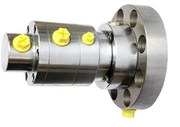
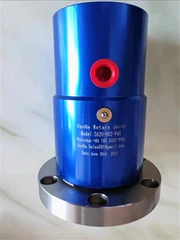
Working principle of hydraulic rotary joint wrench
Jan 15, 2024
The use range of hydraulic rotary joint wrenches is very wide. In the construction, maintenance, and emergency repair of industries such as shipbuilding, petrochemicals, construction, power, mining, and metallurgy, hydraulic wrenches are a very important tool for the installation and disassembly of large-sized bolts.
The irreplaceability of other tools. Not only is it convenient and lightweight to use, but the torque provided is huge and very accurate. The torque repeatability accuracy reaches about ± 3%. According to relevant statistics, about 50% of equipment operation failures are caused by bolt problems, and the number of major equipment accidents caused by bolt problems is also astonishing. Therefore, in the process of equipment installation, maintenance, and gun repair, the torque requirements for bolt tightening and disassembly are generally strict, and manual methods are difficult to meet the requirements. Hydraulic wrenches are an ideal choice for providing large torque specifications for bolts.

The working head of a hydraulic rotary joint wrench mainly consists of three parts: frame, oil cylinder, and transmission components. The output force of the oil cylinder is formed by the piston rod of the oil cylinder and the transmission part as a motion pair. The distance from the center of the oil cylinder to the center of the transmission part is the amplification force arm of the hydraulic wrench. The output force of the oil cylinder multiplied by the force arm is the theoretical output torque of the hydraulic wrench. Due to the existence of frictional resistance, the actual output torque of the hydraulic wrench is smaller than the theoretical output torque.